
Automated Spray Nozzle Testing for R&D Validation
A global consumer goods manufacturer validated proprietary manual sprayer and nozzle performance across a full lifecycle using a custom vision, actuation, and fluid control system built on LabVIEW.
Project Summary
A global consumer goods manufacturer engaged Cyth Systems to design and deliver an automated R&D validation platform for a proprietary dual-chamber trigger spray bottle. The solution simulates thousands of human trigger actuations across a full product lifecycle, continuously monitors the water-to-concentrate mix ratio via a geometry-based machine vision system, and operates autonomously automatically managing water replenishment, pressure conditions, and cycle-by-cycle data logging.
System Features & Components
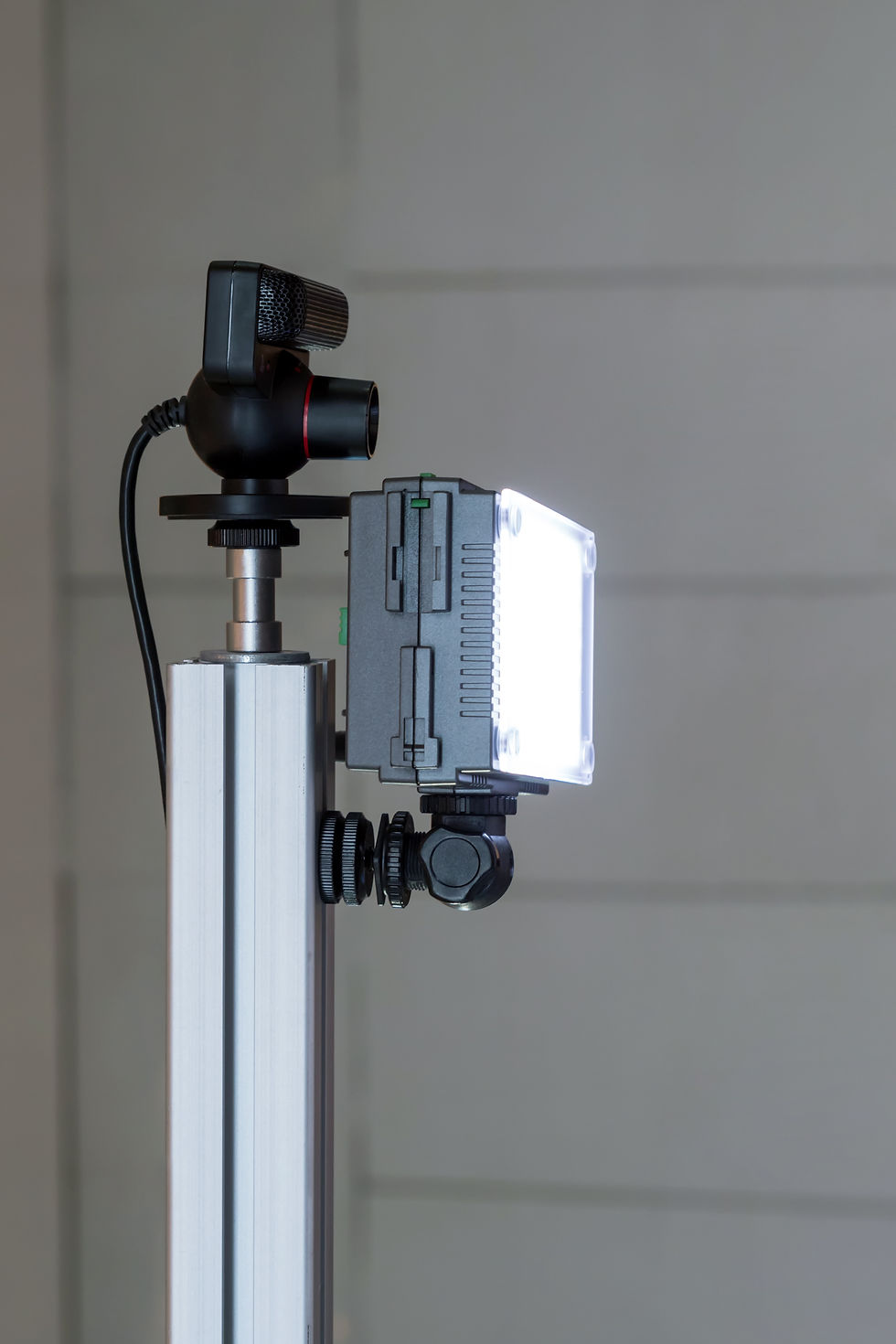
Allied Vision industrial cameras and front-panel LED illumination measure fluid levels in two chambers at sub-milliliter accuracy using a geometry-based lookup table
Configurable force profiles on a Toyo DMG25 stepper-driven linear actuator simulate manual trigger actuation variables across 2,000+ cycles per test
Vision-triggered refill logic and an integrated pinch valve enable a closed-loop peristaltic pump to maintain spray pressure conditions throughout automated solution replenishment
LabVIEW application orchestrates all subsystems, delivering real-time mix ratio graphing, rolling volume averages, outlier filtering, and CSV data export
Outcomes
The manufacturer's R&D team increased test throughput four-fold, trading an eight-hour manual process for a fully automated vision-based platform. They gained patent-defensible mix ratio data that mass and volume measurement methods could not previously produce. System findings directly informed a design changes to the spray nozzle to improve spray profiles and nozzle longevity.
Technology-at-a-Glance
Toyo DMG25 linear actuator
Allied Vision 1800 U-2050m industrial cameras
Front-panel LED illumination array
Closed-loop peristaltic pump
Pinch valve assembly
Custom 3D-printed fixture for holding spray bottle
The limits of manual validation
A consumer products manufacturer bringing a new spray product to market faced a validation challenge: dispense ratio, actuation force, and lifecycle performance all needed to be proven with data rigorous enough to close the gap between intuition and proof. Their patented nozzle design relied on a precise water-to-concentrate mix ratio, which needed to be validated under real-world actuation conditions, across a full product lifecycle, with data rigorous enough to stand behind a patent. The manual testing methodology they had leveraged throughout the initial phases of product development were not sufficient for acquiring the data necessary to achieve a patent.
Validating proprietary technology without reliable data
The manufacturer's R&D team was validating spray head performance entirely by hand, a process that required nearly eight hours per test. Manual testing also introduced inconsistency that undermined the data.
The angle, grip, and force applied to the spray head varied between operators, and continuously measuring mass and volume were not sufficient to reliably characterize what was happening inside the bottle.
Mass measurement couldn't distinguish between concentrate and water.
Volume measurement was complicated by the bottle's geometry because the cross-section varies throughout the chamber, so a fixed height-to-volume relationship could not be assumed.
The team needed a way to see inside the bottle and repeatably measure what was being expelled without any operator actuation in the loop.
Automating a full product lifecycle test
The manufacturer turned to Cyth Systems, who reframed the measurement problem; rather than measuring what came out, they measured what remained inside. A two camera Allied Vision machine-vision system monitors fluid levels in both chambers continuously, using a sliced cross-section model of the bottle geometry and a lookup table to calculate volume from pixel height with sub-milliliter accuracy. A Toyo DMG25 stepper-driven linear actuator simulates trigger actuation with tunable, repeatable force. A closed-loop peristaltic pump and pinch valve manage automatic water replenishment while maintaining the air pressure the spray mechanism depends on. LabVIEW ties all three subsystems together into a single coordinated test platform; reducing an eight-hour manual process to two hours of automated, continuous operation.
Integrating actuation, machine vision, and fluid control
The core measurement challenge was that neither mass nor volume could reliably characterize mix ratio inside a dual-chamber spray bottle. Cyth's solution was to model the bottle geometry directly.
Using a sliced cross-section of the bottle, the team built a lookup table mapping pixel height to remaining volume at discrete intervals, then interpolated between slices to achieve approximately 60-micron resolution, resulting in to sub-millimeter accuracy in fluid level measurement. The vision system monitors both chambers continuously:
When the water level drops below a defined threshold, the system triggers an automatic refill cycle to a target coordinate
When both chambers read empty, the test is complete
Volume and mix ratio data surface cleanly throughout; the geometry complexity is handled entirely by the system
Getting reliable vision data required overcoming lighting challenges posed by the bottle material. Initial backlit lighting configurations produced hotspots that obscured the fluid interface. Incorporating front-panel LED illumination resolved the contrast problem. Cyth implemented filtering logic to handle occasional outlier readings caused by line-jumping by discarding samples moving unrealistically between frames, keeping trend data clean without manual intervention.
Actionable R&D intelligence and patent-defensible data
The shift from manual to automated testing produced gains beyond cycle time improvement. Across throughput, data quality, and engineering insight, the results augmented what the R&D team could accomplish alone:
Test cycle time reduced from eight hours to two, a four-times improvement in throughput, giving the R&D team the capacity to run more tests, iterate faster, and generate data at the pace product development requires.
Machine vision-based mix ratio monitoring provided reliable, patent-defensible data on spray-head performance that mass and volume measurement methods could not produce, directly supporting the customer's intellectual property validation process.
Configurable actuation profiles gave R&D engineers the ability to deliberately introduce or control human-use variables such as angle, force, and grip characteristics, turning what was previously a source of noise into a controllable test parameter.
System findings informed a nozzle design change, demonstrating that the test rig delivered actionable product insight beyond validation alone.
Replacing an operator-dependent, data-poor manual process with a fully automated R&D validation platform gave the manufacturer the throughput and data quality needed to accelerate product development and back proprietary technology with patent-defensible proof. Cyth built the platform with future development in mind, leaving the manufacturer with a reusable foundation for validating new designs as the product evolves.
Related Posts
Automated Spray Nozzle Testing for R&D Validation

Rocket Sled Testing with CompactRIO-based DAQ & Control

High-Speed Turbine Monitoring System with NI Single-Board RIO

Build your system. We're here to help.
Precision automation for test, control, and performance-critical applications.


